How to choose between Sales Outsourcing, SDR as a Service and Call Center Outsourcing — without losing control
Scaling in B2B rarely breaks because of ambition. It breaks because of capacity. There’s a point where your company has a real market, a clear enough message, and a team that’s pushing — but the system cannot keep up. You don’t necessarily need “more leads.” You need execution, consistent prospecting, or operational capacity to handle volume without degrading experience.
That’s where B2B Outsourcing (or service externalization, if you prefer the term) stops being a tactical fix and becomes an architecture decision: what functions to externalize, what controls you need to preserve governance, and what metrics let you scale without improvising — especially if you are entering Spain or expanding into LATAM without opening local offices or branches.
In practice, most companies that scale in an orderly way lean on three pillars. Not because they are “the only ones,” but because they cover the most common bottlenecks and can be activated incrementally. The natural entry point is the system view of B2B outsourcing services , where all layers fit together.
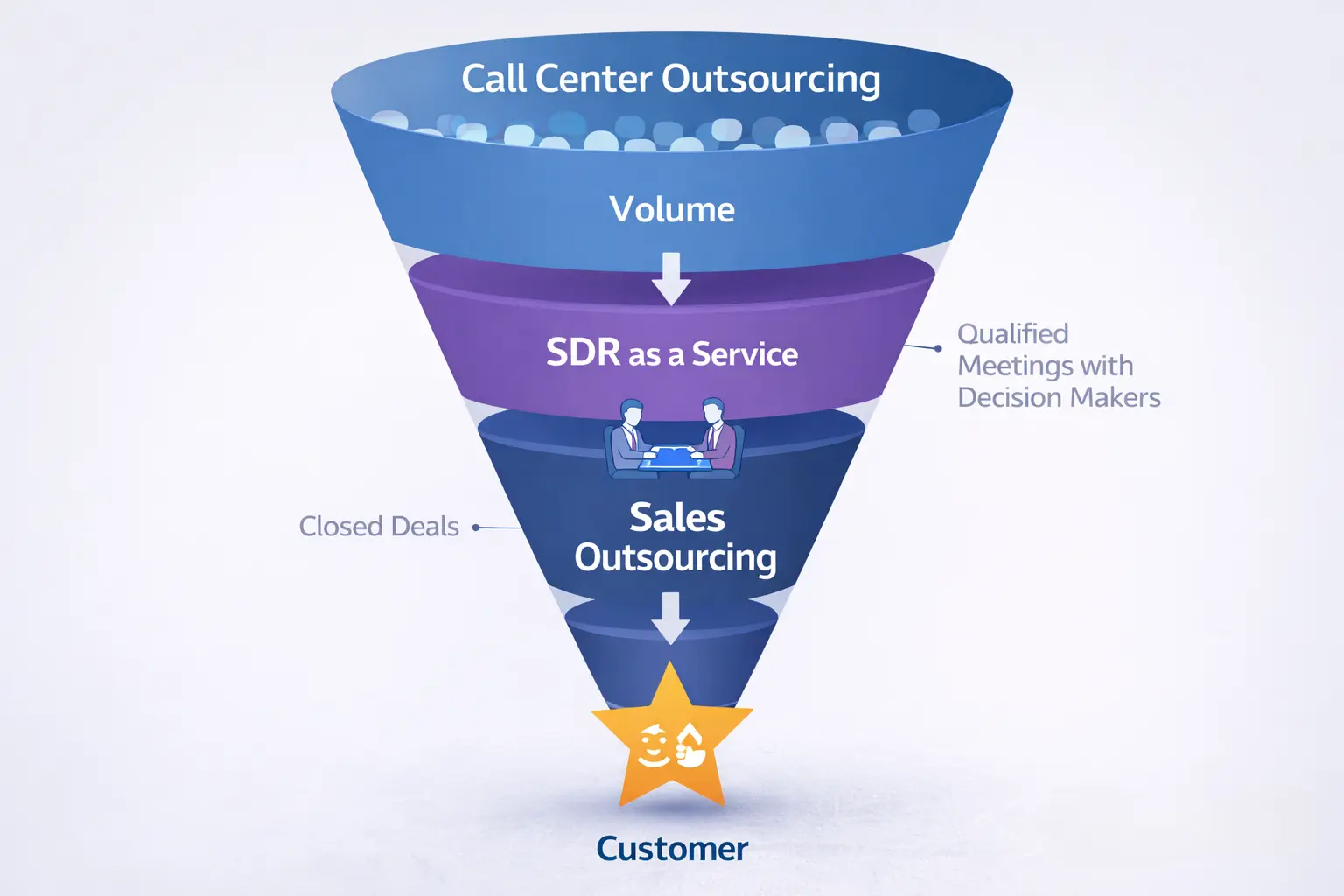
At Outsourcing Planet, we structure B2B outsourcing using what we call the Three-Layer Revenue Architecture. It is not a list of services, but a system for governing scale: how execution is expanded, how pipeline is built, and how operations absorb volume without eroding control.
The model is simple by design. Each layer addresses a different growth constraint — commercial capacity, opportunity creation, and operational stability — and can be activated independently. What matters is not how much you outsource, but how each layer is governed, measured, and integrated into your revenue system.
Pillar 1: Sales Outsourcing B2B (execution and closing capacity)
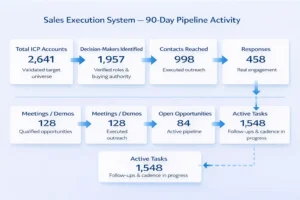
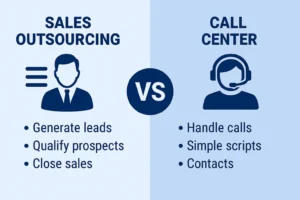
Some companies don’t need “more leads.” They need better conversion: more conversations with decision-makers, stronger follow-up discipline, and a sales operating system that turns interest into real opportunities. In that scenario, Sales Outsourcing is not about delegating selling. It is about adding execution capacity without inflating fixed structure or slowing down the business.
The maturity signal is usually clear: the offer is defined, the market exists, but the pipeline fluctuates or depends too heavily on one or two individuals. The CEO or Head of Sales gets trapped in tactical selling, and the organization pays in focus and speed.
What separates a solid externalization model from a mediocre one is governance. You don’t outsource “so they sell.” You outsource with rules: ICP definition, opportunity criteria, approved messaging, full CRM traceability, and reporting that supports decisions. When those controls exist, outsourcing increases capacity without diluting control.
Secondary reference: Sales Outsourcing B2B in Spain .
Pillar 2: SDR as a Service (outsourced SDR for qualified meetings)
In many B2B teams, the issue is not closing — it is filling the calendar with meetings that deserve the sales team’s time. That is where the second pillar fits: an outsourced SDR layer that builds pipeline with method.
This pillar is especially effective in competitive or international markets, where there are multiple stakeholders and longer sales cycles — typical when entering Spain or expanding into LATAM. Prospecting cannot be massive and generic. It requires minimum account research, value-hypothesis messaging, and qualification criteria. Otherwise, what grows is noise: low-fit meetings, a polluted CRM, and an internal team that gradually stops trusting the funnel.
Well-governed SDR externalization runs on three simple controls: a clear definition of a “valid meeting,” disciplined cadences, and mandatory CRM logging (if it is not traceable, it does not exist). When managed like that, SDR as a Service stops being “lead generation” and becomes an operational revenue layer: continuous message learning, detection of recurring objections, and a more predictable pipeline.
Secondary reference: Outsourced SDR B2B service .
Pillar 3: Business-oriented Call Center Outsourcing (stability under volume)
The third pillar usually becomes relevant when growth creates operational friction. It is not always “support” in the classic sense. It can be customer attention, inbound qualification, commercial research, controlled outreach campaigns, peak-demand handling, or continuity across time zones — particularly when serving Europe and LATAM from Spain.
In B2B, this layer is underestimated until the system starts leaking revenue quietly: leads not handled fast enough, customers waiting too long, incidents accumulating, opportunities cooling down.
A call center that is useful for the business is not measured by call volume. It is measured by operational outcomes: response time, resolution rate, data quality captured, and follow-up consistency. The right design is a process with escalation rules, clear contact-reason taxonomy, and regular QA — so operations do not degrade when volume rises.
Secondary reference: Call center outsourcing for companies .
Why outsourcing for cost is how companies lose control
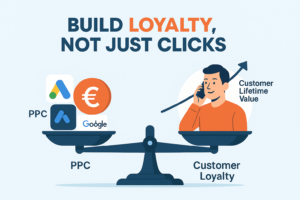
Most companies outsource this layer to reduce cost. That is precisely where control is often lost. The real question is not what you outsource, but what you must never outsource: ownership of data, decision rules, escalation logic, and accountability. When those remain internal, external capacity strengthens the system. When they do not, volume increases while visibility disappears.
How to pick the right pillar without overcomplicating it
If the bottleneck is conversion and closing, Pillar 1 (Sales Outsourcing) is usually the cleanest lever. If the problem is a lack of qualified meetings and the sales team has no “fuel,” Pillar 2 (SDR as a Service) is typically the most direct option. And if growth is already straining inbound qualification, attention, or continuity, Pillar 3 (Call Center Outsourcing) restores operational stability.
In many organizations, the natural order is SDR → Sales: first you generate consistent qualified opportunities, then you scale closing capacity. The third pillar enters when volume requires an operational layer that protects experience and reputation.
At Outsourcing Planet, we frame this choice using a simple executive lens we call the Outsourcing Decision Grid. First, identify where your system is breaking today: pipeline, conversion, or operations. Second, define the level of control you must retain: total, partial, or tactical. The intersection of those two answers tells you which layer must scale first. This is not about adding activity; it is about reinforcing the weakest structural point in your revenue architecture.
Questions worth answering before you outsource
Does outsourcing mean losing control?
Only if you do not define criteria and enforce traceability. With a clear ICP, qualification rules, reporting, and the CRM as the single source of truth, control does not disappear — it becomes measurable.
Is building in-house always “better”?
Not necessarily. In-housing is a long-term continuity and capability-building decision. Outsourcing is a speed, flexibility, and focus decision. Many companies use B2B Outsourcing to build the system first and internalize parts once the process is mature.
How do I avoid activity without impact?
By aligning operational goals to metrics that matter: opportunity quality, valid meetings, stage progression, and loss reasons — not just “number of contacts.”

Conclusion: scale is a system, not a sequence of emergencies
The typical failure mode in B2B growth is not lack of effort. It is structural drift: the pipeline depends on peaks, prospecting becomes inconsistent, operations cannot absorb volume, and decisions are made with partial data because traceability is weak. Over time, the business starts funding activity instead of outcomes.
B2B Outsourcing works when it is designed as a system and governed as a process. The three pillars are not three standalone services; they are three functional layers of scale: sales execution, pipeline creation, and operational stability. If you want to see the full map of options and how they fit together — especially for entering Spain and serving Europe and LATAM without building local branches — the natural starting point is the hub: B2B outsourcing services .