How to Scale Sales Without Hiring: Outsourced Sales for Entrepreneurs and SMEs

Scaling sales used to mean hiring: recruitment cycles, ramp time, management layers, and fixed costs while you wait for pipeline to mature. For entrepreneurs and SMEs, that model is often slow and structurally risky.
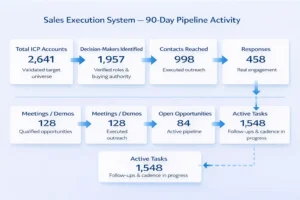
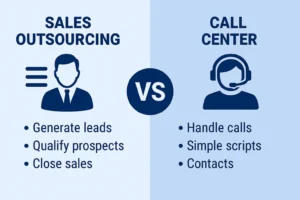
A more controlled path is Sales Outsourcing when it’s delivered as a managed execution system—not “a freelancer making calls”. At Outsourcing Planet, we run sales execution with pipeline governance, follow-up cadences, proposal workflows, and closing discipline—backed by process, QA, and reporting.
This playbook shows how Sales Outsourcing works in practice: the inputs we need, the stages we run, the deliverables you get, and the KPIs that control performance. If your funnel is undefined, start with Sales Systems.
Is Sales Outsourcing a fit?
Strong fit when
- You have a validated B2B offer (real customers, clear value).
- You need consistent execution: follow-up, stage control, proposals, and negotiation support.
- Pipeline exists but deals stall, cycles drag, or closing is inconsistent.
- You want growth without adding headcount and management layers first.
- You want traceability: what was done, why, and what it produced.
Poor fit when
- Your offer changes weekly or pricing/positioning is unstable.
- You can’t commit to clear qualification rules and decision cadence.
- You refuse CRM discipline (stages, data hygiene, reporting).
- You expect instant results without operational foundations.
What Sales Outsourcing means at Outsourcing Planet
Sales outsourcing is not paying for activity. It’s running a controlled execution layer measured by outcomes. Our Sales Outsourcing service is built to increase conversion and predictability by enforcing disciplined execution across the pipeline.
You get a managed execution system
- Stage-based pipeline management (movement rules, next-step discipline).
- Follow-up cadences to prevent opportunities from cooling down.
- Proposal and negotiation workflows (templates, approvals, iteration loops).
- CRM traceability so decisions are based on data, not opinions.
- QA and supervision to keep execution stable as volume increases.
Inputs we need to run execution
To make outsourced sales predictable, inputs must be explicit:
- ICP + exclusions: who we target and who we don’t.
- Offer + pricing: what you sell, deal size, triggers, proof points.
- Sales cycle reality: decision makers, objections, timing.
- CRM access (or agreed stack) with traceability.
- Qualification criteria: what counts as a real opportunity vs noise.
- Response rules: approvals, discount limits, turnaround expectations.
If these inputs are missing, start with Sales Systems first.
The execution framework (step by step)
Below is the operating model. Skim the steps, open the ones you care about, and you’ll understand how Sales Outsourcing is run as a controlled system.
Step 1 — Pipeline audit and stage definition
- Objective: build a pipeline structure that can be governed.
- Deliverables: stage map, movement rules, minimal CRM hygiene standard.
- KPIs: stage conversion, pipeline velocity, stalled-opportunity rate.
Step 2 — Qualification criteria and opportunity control
- Objective: prevent calendars and pipelines from filling with low-fit deals.
- Deliverables: qualification checklist, disqualification rules, handover requirements.
- KPIs: qualified-to-proposal rate, no-show rate, disqualification reasons distribution.
Step 3 — Cadence design: follow-up discipline
- Objective: stop opportunities cooling down due to inconsistent follow-up.
- Deliverables: cadence rules, next-step templates, escalation rules for stalled deals.
- KPIs: time-to-next-step, touchpoints per opportunity, stalled time per stage.
Step 4 — Opportunity progression and deal momentum
- Objective: move opportunities forward with controlled sequences, not reactive chasing.
- Deliverables: stage action playbook, stakeholder map template, objection log pattern.
- KPIs: stage duration, rework loops, progression rate.
Step 5 — Proposal workflow and negotiation support
- Objective: standardise proposals to reduce cycle length and improve close rate.
- Deliverables: proposal template logic, approval thresholds, negotiation checklist.
- KPIs: proposal-to-close rate, discount incidence, time from proposal to decision.
Step 6 — Closing model (two execution options)
- Handover-first: we deliver qualified opportunities with full context and next steps to your closer.
- Full-cycle closing: we run closing end-to-end under agreed approval rules.
- Deliverables: handover pack standard, decision rules, closing workflow.
- KPIs: close rate, forecast accuracy, time-to-close.
Step 7 — CRM traceability and reporting cadence
- Objective: maintain control and eliminate black-box outsourcing.
- Deliverables: weekly report structure, KPI dashboard, decision log.
- KPIs: forecast reliability, pipeline coverage, stage hygiene compliance.
Step 8 — Continuous optimisation (metrics-driven)
- Objective: improve conversion and cycle time through controlled iteration.
- Deliverables: optimisation backlog, changes log, measured impact notes.
- KPIs: conversion uplift by stage, cycle time reduction, win/loss drivers.
Where SDR fits
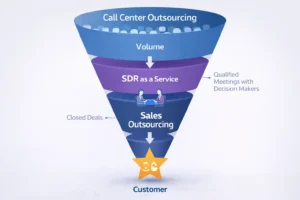
If the constraint is not enough qualified meetings, upstream execution should be handled by SDR as a Service so sales execution receives clean, defined opportunities instead of noise.
Optional add-on: Call Center (when volume requires it)
When operations become the constraint (volume follow-ups, reactivation, support-oriented calls), our Call Center Outsourcing layer can be integrated with SLAs, QA, scripts, and reporting.
Common failure modes
- Unclear offer: if value and pricing logic aren’t stable, execution stalls.
- No governance: slow decisions and approvals inflate cycle time.
- No qualification discipline: pipeline turns into noise.
- No CRM discipline: optimisation becomes impossible.
If any of the above is true, fix structure first with Sales Systems, then activate execution.