Why Your Sales Team Isn’t Selling: Clear Signs and How to Fix It
There is a very specific moment in almost any company when the comfortable story breaks. You keep investing. You keep “doing things”. You keep pushing. And yet sales don’t go up. Worse: sometimes they drop.
At that point, many SMEs in Spain choose a quick explanation because it hurts less than a complete truth. “The market is weird.” “Competitors are dropping prices.” “Nobody buys anymore.” “Leads are poor quality.” Some of that can be true—but if you’re reading this, you already suspect what many leaders avoid: the problem isn’t always outside.
In most cases, the problem is internal. In the sales team, in the standard you tolerate, and—above all—in the structure that sustains it. Comfortable reps. Outdated habits. No external benchmark. Protected by inertia and leadership that prefers not to touch what “has always worked”.
This is not a motivational article. It’s about real sales execution: why your team isn’t selling and what you can do to fix it without destroying the company, without creating internal fear, and without turning the office into a permanent trial.

The real signs your sales team isn’t selling (and why it’s not the market)
Signal 1: You confuse activity with sales
A sales team can look extremely busy and still be ineffective. Internal meetings, emails, “just in case” proposals, calls to old accounts, follow-ups that go nowhere. From the outside, it looks like movement. From revenue, nothing happens.
This is the first trap: confusing effort with performance. Some companies have reps who “work”, but they don’t have a commercial system that turns that work into pipeline—and pipeline into closed revenue.
When there is no system, excuses become the official language. Leadership—tired—ends up buying them because there is no objective framework to compare against. Without clear metrics, without external standards and without process, the conversation becomes opinion. And opinion never runs sales.
Signal 2: Your team lives in a bubble with no external benchmark
This is more common than it sounds, especially in SMEs or small teams: there is no benchmark. No bar. No competitive friction. After years with the same structure, the company starts accepting as “normal” what the market already considers mediocre.
The most useful uncomfortable mirror is to look sideways. Not to copy, but to understand the current standard: which roles are being created, which capabilities are now baseline, which tools are assumed, and what discipline is expected.
If you do that honestly, a question appears that hurts—but frees: if the standard out there has risen, why are we still measuring ourselves with old rules inside?
Without external comparison, expectation drops. When expectation drops, comfort rises. That combination rarely kills fast. It kills slowly.
Signal 3: Comfortable reps—and an excuse catalogue that costs you money
When a sales team is switched off, excuses become sophisticated. They don’t sound like laziness. They sound like experience—and that’s why they’re dangerous.
“We’re expensive.” “Competition is strong in Spain.” “Customers compare too much.” “Nobody buys anymore.” Sometimes there’s a seed of truth. But often these are alibis to avoid improving positioning, avoiding structured prospecting, and avoiding leading the conversation.
The reality is usually simpler: customers buy—but they don’t buy from you.
If leadership accepts these phrases as final truth, the team learns a comfortable dynamic: there is always an external cause. And if there is always an external cause, there is never internal improvement.
Signal 4: The “untouchable” and the leader who doesn’t dare restructure
In many companies in Spain there is an “untouchable” figure. Not always because they’re brilliant, but because of tenure, dependency, or cultural fear.
“They’ve been here for 20 years.” “If they leave, everything collapses.” “They’re the only one who knows how this works.” That story is understandable emotionally—but lethal operationally.
Dependency on an untouchable isn’t a problem of that person. It’s a model problem. If a company cannot demand performance because it fears losing someone, the standard stops existing.
Signal 5: You invest more—but you sell less
Here marketing acts as a mirror. Many companies invest more in visibility, campaigns and lead generation. Contacts arrive. And still, sales don’t go up.
The key question is not how many leads come in, but what happens when they enter the sales system. Late follow-ups, calls without a plan, proposals without diagnosis, and fear of prioritising.
If you can’t execute even when opportunities exist, the problem is not demand. It’s method.
How to fix it — Sales re-education and a new pipeline engine
Action 1: A sales audit without drama
Any serious change starts by understanding what is really happening. Not intuition. Not feelings. Not biased internal narratives. A proper sales audit is not about blaming people; it’s about seeing the full movie: how conversations start, how leads are qualified, how value is presented, how follow-up happens, and how deals are closed.
When that analysis is done with external criteria and without fear, the comfortable narrative of “it’s the market” collapses fast—and something far more useful appears: a clear map of friction, inefficiencies and real improvement opportunities.
Action 2: Sales re-education and method upgrade
Sales reps don’t reactivate with motivational speeches or constant pressure. They reactivate when they feel competent in today’s market again. That means revisiting messaging, qualification, negotiation, conversation control and daily habits.
Selling today is not about “working harder”. It’s about working better: prioritising properly, understanding the decision-maker, leading the conversation and executing with method. Without technical upgrading, even experienced profiles end up operating on autopilot.
Action 3: External comparison and raising the bar
One of the most powerful—and least used—tools is healthy comparison. Expose the team to real market standards, modern ways of working, and clear metrics that don’t depend on tenure or internal politics.
This is not about humiliating anyone or creating fear. It’s about waking up. When the bar rises with clear criteria, comfort stops being an option. Experience stops being armour and becomes responsibility.
Action 4: Activate a pipeline engine that removes excuses
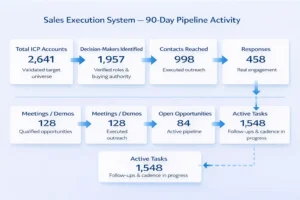
If you want excuses to disappear without internal conflict, you need a consistent pipeline. A system that generates real conversations with decision-makers and does not depend on the team’s mood.
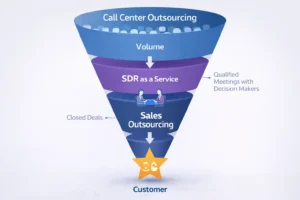
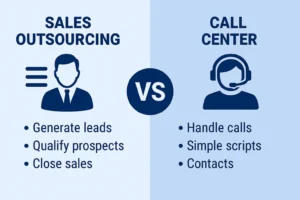
This is where a model comes in that doesn’t compete with your team—it amplifies it: an SDR B2B team that prospects, qualifies and books meetings so your internal closers focus on what they should do: close.
This change does not necessarily mean spending more. In many companies it means reallocating investment: less obsession with PPC that doesn’t convert and more focus on real conversations with the right accounts. When pipeline is stable, excuses collapse by themselves.
At Outsourcing Planet, we work from two angles depending on your starting point. If the problem is structural, we enter with strategic sales consulting and sales audit. If the problem is pipeline, we activate outsourced SDR as an extension of your team. In both cases, the goal is the same: build a commercial system you can measure, adjust and scale.
If you made it this far, you already know the problem won’t be solved with more pressure or more campaigns.
At this point, it makes sense to rely on strategic sales consulting or on an outsourced SDR B2B model that removes excuses and brings predictability back to your pipeline.

Conclusion: when you normalise the problem, sales stop existing
If your sales team is switched off, the signs are usually clear: pipeline depends on streaks, follow-up is inconsistent, opportunities die silently, and the company talks more about why “it can’t be done” than what will be done. When this repeats, leadership stops financing results and starts financing attempts. That’s the moment the problem stops being the market and becomes structural. This is not about painting your reps as villains. It’s about recognising what many companies refuse to admit: sales mediocrity becomes normal when there is no standard, no external comparison, and leadership buys excuses out of fatigue. The good news is that it can be fixed. Not with more pressure, but with structure: audit, method, external benchmarks and a modern pipeline engine. When that exists, the company sells again—and does it predictably.
When sales don’t depend on the market but on structure, you have two options: keep adjusting internally with no external reference, or introduce criteria, method and real comparison.
Some companies start by reviewing their sales model—roles, metrics and closing process—to understand what is actually failing in their sales structure .
Others go one step further and activate a system that injects conversation, comparison and rhythm from the outside, relying on professional B2B prospecting that generates real pipeline so the internal team can focus on closing.
These are not shortcuts. They are structural decisions for the same objective: stop financing attempts and operate with predictability again.
Was this useful?
Share it with your team or other sales leaders: