What Is Sales Outsourcing and How Can It Revolutionize Your Business in Málaga, Andalusia, and Beyond?
Reading Time: 12–15 min • Author: Outsourcing Planet

Contents
- What Is Sales Outsourcing?
- What Is a Sales Outsourcing Company?
- Why Málaga & Andalusia Are a Strong Fit for Sales Outsourcing
- How Does Sales Outsourcing Work? (The Operating Model)
- Roles, Team Structure, and What You Actually Get
- Who Should Outsource Sales (and who shouldn’t)
- KPIs, Reporting, and Governance: What “Control” Looks Like
- Contract Models: Retainer, Variable, Commission, Hybrid
- Risks of Sales Outsourcing (and How to Mitigate Them)
- How to Choose the Right Sales Outsourcing Partner
- A Realistic Example (Málaga-Based Expansion)
- Ready to Outsource Sales with Structure?
What Is Sales Outsourcing?
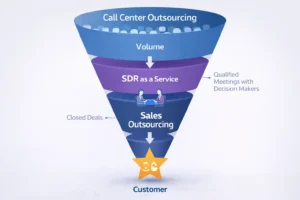
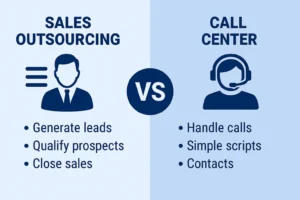
Sales outsourcing is the delegation of some or all of your sales execution to a specialized partner that operates as an extension of your company. The key word is execution: prospecting, qualification, pipeline management, follow-up cadence, closing support, and measurable reporting.
Done correctly, sales outsourcing is not “renting a salesperson.” It is gaining access to a structured commercial engine: people, process, tools, playbooks, and governance—so activity becomes pipeline, and pipeline becomes revenue.
If you want the full operating model and service scope, start here: Sales Outsourcing (Service Overview).
What Is a Sales Outsourcing Company?
A sales outsourcing company is a partner that provides a repeatable system to execute sales without you building an internal department from scratch. The best providers don’t just “sell”; they build a controlled operating layer around selling—so you can scale without losing visibility.
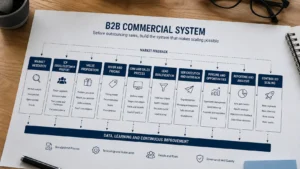
At Outsourcing Planet, the model is simple: we don’t deliver isolated individuals. We deliver a sales execution system backed by a team, processes, supervision, and infrastructure.
Primary reference: Sales Outsourcing in Spain (B2B execution system).
Why Málaga & Andalusia Are a Strong Fit for Sales Outsourcing
Málaga and Andalusia are a practical environment for outsourcing sales because they sit at the intersection of:
- International demand (tourism, real estate, services, and cross-border business).
- Growing tech and SME ecosystem needing structured go-to-market execution.
- Nearshore execution capacity with strong cultural alignment for Spain and wider Europe.
That said, the approach is not “local only.” Málaga is the execution base; the sales system can target Andalucía, Spain, and international markets—if the ICP and offer are clear.
How Does Sales Outsourcing Work? (The Operating Model)
A proper sales outsourcing engagement is not a single step. It is a sequence that creates control before scaling activity:
Phase 1 — Sales system alignment (fast, pragmatic)
- ICP definition (who we target, who we ignore).
- Offer and messaging structure (what we say, how we qualify).
- Pipeline stages and qualification criteria.
- Tooling alignment (CRM, tracking, reporting).
If your system is unclear, do not “outsource harder.” Start by structuring the base: B2B Sales Systems.
Phase 2 — Technical kickoff
- CRM setup or cleanup (stages, fields, ownership, hygiene rules).
- Channel configuration (email domains, call setup, sequencing).
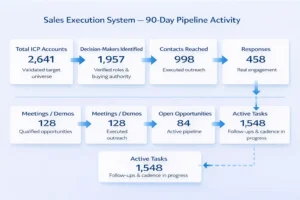
- Reporting dashboard: activity → meetings → opportunities → revenue.
Phase 3 — Execution cadence
- Prospecting and outbound sequences (email, calls, LinkedIn where appropriate).
- Qualification and meeting setting based on defined criteria.
- Follow-up discipline (the most common failure point in SMEs).
Phase 4 — Optimization and scaling
- Message iteration based on responses, not opinions.
- ICP refinement based on conversion rates.
- Territory expansion once the machine is stable.
For the service version of this model (what we execute, how we scope it, and how it’s governed), go here: Sales Outsourcing.
Roles, Team Structure, and What You Actually Get
Sales outsourcing fails when companies think they are buying “a person.” You are buying a system. That system typically includes:
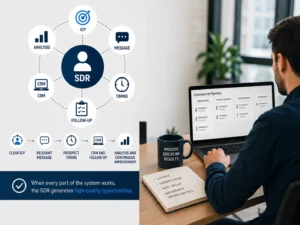
- Sales Development (SDR/BDR): target list building, outreach, qualification, meeting setting.
- Closing support: deal progression, follow-up, proposal coordination, objections, next steps.
- Ops layer: CRM governance, reporting, data discipline, and process control.
- Management: supervision, performance reviews, playbook updates, quality assurance.
The deliverable is not “activity.” The deliverable is a visible pipeline with traceable conversion rates.
Who Should Outsource Sales (and who shouldn’t)
Outsource sales if:
- You have a validated offer and need execution capacity.
- You want to scale without building fixed headcount immediately.
- Your internal team lacks consistent prospecting and follow-up discipline.
- You need structure, governance, and reporting—not “sales hustle.”
Do not outsource sales yet if:
- Your ICP is undefined and you’re still guessing who to target.
- Your offer is unclear, pricing is unstable, or the sales narrative is inconsistent.
- You cannot deliver operationally after the sale (capacity constraints).
If you’re in the “not yet” bucket, you still can move fast—just structure first: Sales Systems.
KPIs, Reporting, and Governance: What “Control” Looks Like
A serious sales outsourcing engagement must be governed. Otherwise you get volume without quality. Minimum governance includes:
- Activity KPIs: touches/day, call attempts, emails sent, sequence completion.
- Meeting KPIs: meeting rate, show rate, qualification pass rate.
- Pipeline KPIs: opportunities created, stage conversion, sales cycle length.
- Revenue KPIs: win rate, average deal size, forecast accuracy.
The purpose of governance is simple: you should be able to answer, weekly, “what happened, why it happened, and what changes next week.”
Contract Models: Retainer, Variable, Commission, Hybrid
Most sales outsourcing contracts fall into a few patterns. Each has trade-offs:
- Retainer: stable execution capacity, best for building a predictable engine. Lower volatility, clearer management.
- Retainer + variable: aligns incentives without gambling the entire engagement. Often the most balanced model.
- Commission-only: can work in certain high-velocity contexts, but frequently produces misalignment or low-quality volume if governance is weak.
- Project / pilot: limited time-boxed test to validate ICP, messaging, and initial conversion metrics.
The correct model depends on sales cycle length, ticket size, and the maturity of your system—not on preference.
Risks of Sales Outsourcing (and How to Mitigate Them)
Sales outsourcing has real risks. The goal is to mitigate them structurally:
- Brand/control risk → solved with messaging rules, approval loops, and QA.
- Low-quality pipeline → solved with strict qualification criteria and transparent KPIs.
- CRM “fiction” → solved with governance rules and pipeline hygiene discipline.
- Vendor dependency → solved with documentation, playbooks, and transferability.
If a provider can’t show you governance, reporting, and accountability, you’re not outsourcing sales—you’re outsourcing uncertainty.
How to Choose the Right Sales Outsourcing Partner
This is the practical checklist. A serious partner should be able to answer clearly:
- What is your operating model (roles, management, reporting cadence)?
- How do you define and enforce qualification?
- How do you guarantee CRM traceability?
- What do weekly reports look like (and what decisions they enable)?
- What happens if messaging or ICP is wrong—how fast do you iterate?
If you want the service implementation rather than a theoretical guide, go straight to: Sales Outsourcing.
A Realistic Example (Málaga-Based Expansion)
A Málaga-based B2B company wants to expand across Andalucía and then to the rest of Spain. Instead of hiring a full internal team, it activates sales outsourcing with a defined ICP and clear qualification rules.
- Week 1–2: ICP + message alignment, CRM setup, reporting.
- Week 3–4: outbound sequences live, first meetings booked.
- Month 2: pipeline stabilizes; conversion rates guide ICP refinement.
- Month 3+: territory expansion with proven playbook.
The company remains focused on delivery and operations while the outsourced system generates controlled pipeline.
Ready to Outsource Sales with Structure?
If you want sales outsourcing executed as a system (not as an individual), start here:
Sales Outsourcing (Outsourcing Planet)
If you first need clarity and structure before scaling execution:
Related articles: