What Exactly Does an SDR Do in B2B Sales?
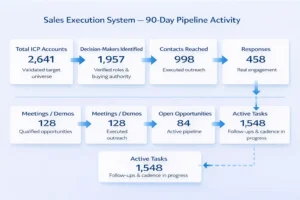
An SDR’s job is to identify target companies, reach out to them, validate whether there is real interest and filter which opportunities are worth moving forward. To do that, they use calls, email, LinkedIn and other outbound prospecting channels.
But the role is not just about finding contacts. A strong SDR works with method, judgement and follow-up. They do not simply create activity; they create conversations with real commercial potential and generate useful market feedback, including objections, response patterns and message performance.
That is why the SDR plays a key role inside a
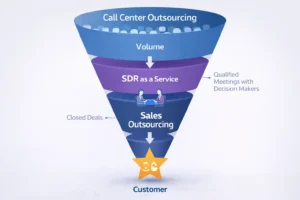
B2B sales system. They are the function that turns a cold base into real opportunities for the closing team.
What an SDR Should Not Be Doing
When the commercial structure is properly designed, an SDR should not be closing complex deals, handling administrative tasks, resolving issues or becoming general support for any task labelled “sales”.
As soon as the role loses focus, prospecting loses consistency. And when prospecting breaks down, what drops is not only present activity, but the future flow of opportunities as well.
Why an In-House SDR Often Gets Diluted
An in-house SDR can work well, but only when the company already has a clear sales structure, a defined process and a real separation between prospecting and closing.
In many small and mid-sized companies, that is not the case. The person hired to prospect ends up absorbing CRM tasks, proposal follow-up, internal sales support and other work that does not belong to the role. The result is a hybrid profile with no focus and no clear metrics.
On top of that, many companies try to add an SDR before clearly defining their ideal customer profile, their value proposition or their prospecting system. In that situation, the problem is not just the person. The problem is the lack of structure.
In-House SDR vs Outsourced SDR
The real comparison is not just between one internal person and one external person. It is between building a function from scratch or activating a function that is already structured.
An in-house SDR requires the company to define processes, messaging, supervision, reporting and operating control internally. If that does not exist, the hire arrives before the system does.
An
outsourced SDR, by contrast, usually comes with a defined methodology. That reduces ramp-up time, improves focus and allows prospecting to be executed with more consistency.
On top of that, an outsourced SDR is usually more protected from internal noise. They are not constantly pulled into unrelated tasks, which improves the performance of a role that depends on continuity.
Why Outsourcing SDR Can Be More Effective
For many B2B SMEs, the main problem is not closing deals. It is generating a steady flow of qualified meetings. Without that first layer, the funnel runs dry.
Outsourcing SDR makes it possible to activate B2B prospecting without building a department from scratch. It adds speed, reduces dependence on a single hire and keeps the function focused on prospecting, qualifying and opening meetings.
That said, outsourcing well does not mean hiring someone loosely to send messages. It means integrating a function backed by process, supervision, segmentation and control.
When
SDR outsourcing is properly designed, the company does not just gain activity. It gains order, traceability and a more solid base for growth.
When It Makes Sense to Build In-House and When It Makes Sense to Outsource
An in-house SDR can make sense when there is already sales leadership, an outbound process, tools, supervision and the capacity to protect the role properly.
But when the company does not yet have that base, outsourcing is often more effective. It allows prospecting to start without improvising an incomplete internal structure or burdening the team with a function that nobody ends up managing well.
What a Serious SDR Outsourcing Provider Should Offer
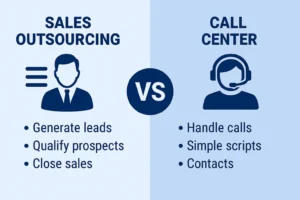
A serious SDR outsourcing provider in Spain should not be limited to sending emails or making calls. They should work on the ideal customer profile, the message, the segmentation, the contact methodology and the quality of the opportunities being generated.
They should also provide clear reporting and a working logic that shows which market is being targeted, what response is being achieved and which meetings have real value for sales.
The point is not to provide just a human resource, but to deliver an SDR function backed by system, process and execution. That is where a
sales outsourcing model that is properly designed makes the difference.