When companies expand into Spain or Latin America, they often start with a simple assumption: hiring a local sales rep will unlock the market. On paper it sounds efficient—one person with experience, relationships, and autonomy who can “run sales” without increasing headcount.
In practice, this approach tends to create the same failure pattern: dependency on a single individual, low visibility into what’s happening day-to-day, inconsistent pipeline quality, and fragile results that disappear the moment execution slows down.
B2B sales outsourcing is not about “adding a salesperson.” It is about implementing a sales execution system—a structured, measurable operation that can reliably generate, qualify, and convert pipeline in a new market.
In complex B2B environments—longer sales cycles, multiple stakeholders, local nuance, and higher trust requirements—performance is rarely a talent issue. It is an execution and governance issue.
What B2B sales outsourcing really means
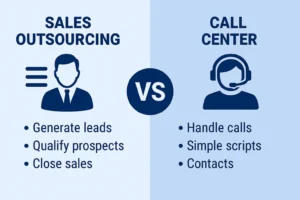
B2B sales outsourcing means delegating sales execution within a defined operating structure, not outsourcing tasks to disconnected individuals. The goal is to run a consistent commercial engine that behaves like an extension of your business—aligned on ICP, positioning, qualification standards, process, tooling, and reporting. In practice, that is what B2B sales outsourcing as an execution system looks like: governed activity, measurable pipeline, and repeatable output.
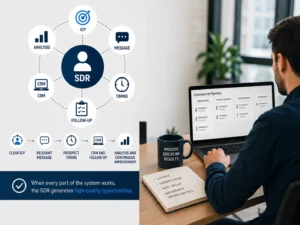
A serious outsourced sales setup is not “a rep making calls.” It is an execution layer with clear rules: what counts as a qualified opportunity, how follow-ups are handled, how CRM data is governed, and which metrics determine whether the system is improving or drifting.
The useful question is not: “Which salesperson should we hire?” It is: “Which system do we need so qualified people can execute consistently?”
Outsourcing sales vs. hiring a local rep: the real difference
When sales outsourcing is treated as “bringing someone in to sell,” the result is a replica of the traditional in-house model—only with less control and more dependency. That is why many “outsourced sales” efforts feel busy but fail to compound: pipeline activity exists, but pipeline quality and structure do not.
When outsourcing is designed as a system, it becomes a capacity decision. You define the funnel, govern the stages, and improve execution using data—not anecdotes.
The difference is practical and structural: in one model, outcomes depend on a person. In the other, outcomes depend on a method.
What sales outsourcing is not
Sales outsourcing is not hiring a “cheaper rep” to fill a gap. It is not asking one person to prospect, qualify, close, report, manage accounts, and diagnose the market simultaneously.
It is also not delegating without governance: no ICP definition, no qualification standards, no CRM ownership, no consistent reporting, and no cadence discipline. That is not professional outsourcing; that is outsourced uncertainty.
Under those conditions, results become erratic—and the business becomes exposed to the variability of a single individual. Which defeats the core reason companies outsource in the first place: continuity and control.
What it is in practice: a disciplined pipeline system
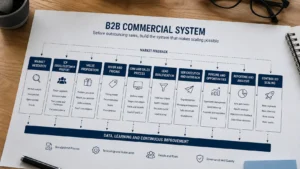
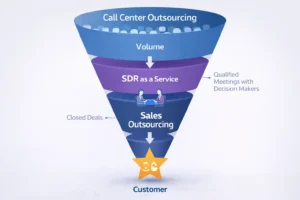
A strong outsourced sales system is built to create and convert pipeline with discipline. It replaces ad-hoc selling with a clear sequence: target definition, outreach, qualification, opportunity progression, negotiation, and closure—tracked in a CRM with real traceability.
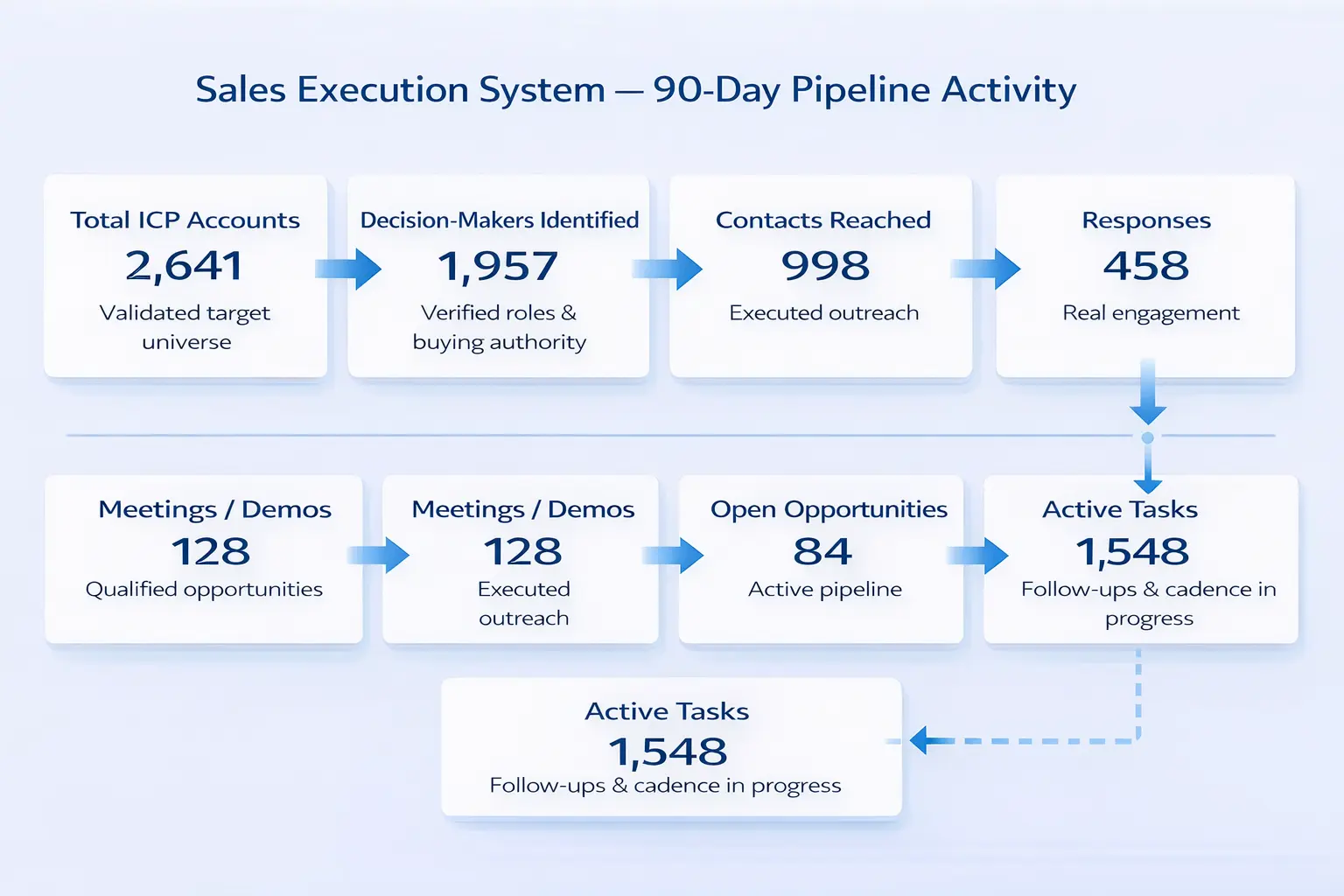
When this is done properly, three things happen quickly: pipeline starts to take shape (not just activity), conversations become consistent (messaging and qualification stabilize), and leadership gains visibility into what’s actually happening at each stage.
Well-executed sales outsourcing doesn’t replace strategy with execution. It replaces improvisation with method.
What a professional sales execution system includes
In B2B, an execution system usually rests on four pillars: strategic clarity, funnel design, infrastructure, and governance. Without these, sales becomes episodic and hard to repeat.
1) Strategic clarity. You establish the commercial foundation: value proposition, ICP, segments, positioning, messaging, and key objections. Without this, outreach produces noise.
2) Funnel design. You define stages, conversion criteria, what qualifies as a meeting/opportunity, and the follow-up cadence. This prevents the classic mistake: confusing “activity” with “progress.”
3) Infrastructure and data discipline. The CRM becomes the source of truth. Reporting cadence is defined. Automation is used only where it improves consistency. Data quality is managed to prevent pipeline inflation.
4) Governance through metrics. You monitor the variables that actually govern performance: stage conversion, qualification ratios, cycle velocity, win rate, pipeline quality, and activity consistency. When these are clear, the conversation becomes operational—not emotional.
Why the “ideal rep” depends on the system, not the person
Many companies look for the “complete” local rep: prospecting, qualification, closing, reporting, relationship management—everything. Sometimes those people exist. But building your go-to-market around them is structurally fragile.
In a well-designed system, sales roles operate inside a process that makes execution effective. Not because people are interchangeable, but because outcomes stop relying on heroic individual performance.
This is why the ideal profile is, in practice, the one that executes well inside governed structure. Businesses don’t win by finding extraordinary individuals. They win by building a machine where good performance repeats—and problems are diagnosed with data.
For Spain and LATAM expansion, outsourcing reduces uncertainty—not just cost
The real value of sales outsourcing is not savings. It is reducing uncertainty: faster time-to-market, lower dependency risk, operational continuity, and visibility into pipeline reality.
Cross-border B2B expansion introduces additional failure modes: local buyer expectations, language nuance, decision dynamics, and trust-building. Without a governed system, your market entry becomes a sequence of urgencies.
At Outsourcing Planet, we operate sales execution systems for B2B companies expanding into Spain and Latin America, and the pattern is consistent: sustainable results come from structure, not from individual hires.

Conclusion: when sales outsourcing makes sense (and when it doesn’t)
B2B sales outsourcing works when there is a defined value proposition, an identifiable market, and a willingness to operate sales as a governed process. It is particularly effective when companies want to scale into Spain or Latin America without building a full internal structure upfront, or when they need to professionalize pipeline creation and execution control.
It is not recommended when product–market fit is unclear, the ICP is still fuzzy, or when “sales effort” is expected to compensate for positioning or offer weaknesses. In those scenarios, outsourcing does not resolve disorder—it amplifies it.
Ultimately, the decision is not whether to hire someone to sell, but whether to implement a system that sells. In B2B, architecture, method, and governance outperform individual talent over time—because they create traceability and repeatability. Start by defining the structure in B2B Sales Systems. Once the system is ready, activate execution through Sales Outsourcing and turn sales into a reliable operating capability—not a gamble.