What an SDR Actually Does in B2B Sales
An SDR, or Sales Development Representative, works at the front end of the sales process.
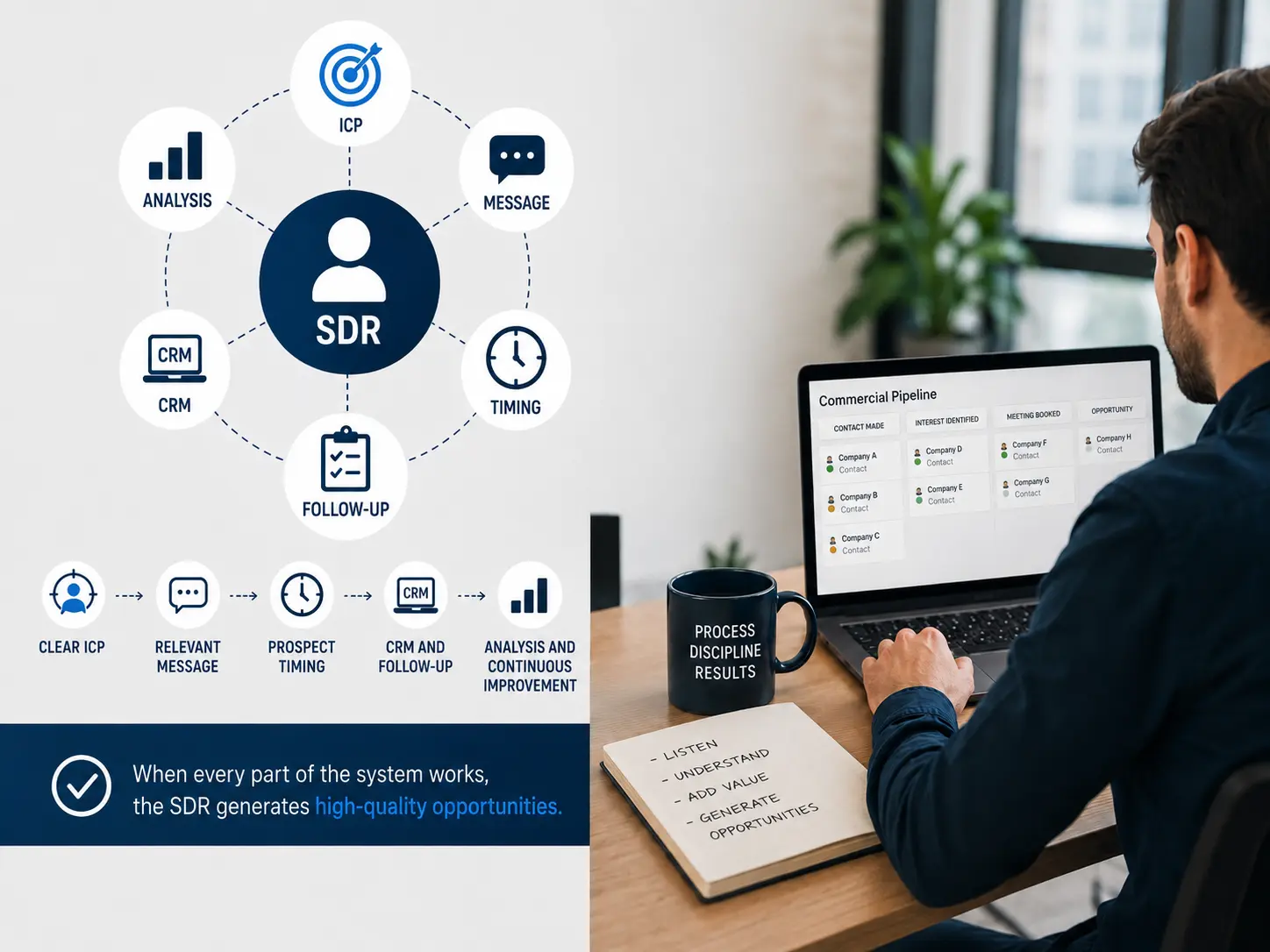
The SDR’s role is to identify target accounts, contact decision-makers, start conversations, qualify interest and generate meetings for the sales team.
This is not a closing role. It should not be treated as a general sales position. The SDR operates before the commercial opportunity is fully mature. Their job is to turn a cold or early-stage account into a qualified opportunity worth advancing.
In B2B sales, this requires more than sending emails or making calls.
An SDR needs to understand the ideal customer profile, identify buying signals, adapt the message to each account, register useful information in the CRM and maintain a structured follow-up cadence.
When the role is understood correctly, the SDR is not simply “doing outreach”. The SDR is an operational part of a larger sales architecture.
That architecture becomes even more important when the company is selling into a new country.
Why Entering Spain Requires More Than Outreach
Spain is not a market that can be approached only with translated messaging and generic outbound sequences.
A company entering the Spanish B2B market needs to understand who the real decision-makers are, how companies evaluate external providers, how long decision cycles usually take, what level of trust is required before a first meeting, and how prospects respond to direct commercial outreach.
Some companies expect the SDR to solve all of this through activity. That is a mistake.
If the ICP is not clear, if the value proposition is not adapted to the Spanish market, if the messaging sounds foreign or generic, if follow-up is inconsistent and if the CRM is not used properly, the SDR starts at a structural disadvantage.
In that situation, the SDR is not executing a sales system. The SDR is trying to build one while prospecting.
The result is predictable: high activity, limited traceability, inconsistent messaging, weak follow-up and unrealistic expectations.
The company measures meetings, but does not measure market signals. It expects immediate results, but does not analyse whether the message is working. It pressures the SDR, but does not correct the system around the SDR.
An SDR without a system
can generate activity.
An SDR inside a system
can generate accumulated market intelligence.
That distinction is critical.
Why Individual Effort Is Not Enough
Sales development is difficult because the SDR operates in an uncertain environment.
The SDR contacts people who did not ask to speak with the company. They try to create pipeline from cold or low-awareness accounts. They are often measured on activity before outcomes.
But many of the variables that influence success are outside the SDR’s control.
The SDR does not control the product. They do not control the company’s positioning. They do not control whether the prospect has budget. They do not control the internal timing of the target account. They do not control whether the Spanish market already understands the category or needs education first.
That is why it is a mistake to treat every non-response as an individual SDR failure.
In complex B2B sales, opportunities often do not appear in the first interaction. They are built through repetition, context, timing, follow-up and trust.
The SDR needs a structure that tells them when to push, when to pause, when to re-engage and when to disqualify an account.
Without that structure, outreach becomes pressure.
With structure, outreach becomes process.
Prospect Timing Matters in Spain
One of the most common mistakes in B2B prospecting is interpreting silence as failure.
A Spanish prospect may not respond for many reasons: no urgency, no budget, internal saturation, wrong contact, poor timing, lack of trust, or simply because the problem is not yet an active priority.
That does not necessarily mean the account has no value. It may mean the timing is not aligned.
A mature SDR function does not only chase immediate responses. It classifies signals. It identifies whether an account has fit but no timing, whether the correct decision-maker has not yet been reached, whether the message needs a different angle, or whether the opportunity should be placed into a future follow-up sequence.
This is why the CRM cannot be treated as an administrative tool.
The CRM is the commercial memory of the market-entry process.
It should show what was attempted, who was contacted, what response was received, what objection appeared, what timing was detected and what next action makes sense.
Respecting prospect timing is not passive. It means avoiding the destruction of valuable accounts through poorly applied commercial pressure.
What an SDR Needs to Generate Real B2B Opportunities
An SDR needs much more than a list of contacts.
1. Clear ICP
The company must define what type of Spanish company actually fits the offer: sector, size, geography, operational complexity, decision structure, commercial pain and potential urgency.
2. Segmentation
Not every account should receive the same message. A technology company, an industrial supplier, a private education provider, a logistics operator or a professional services firm may all belong to B2B, but each requires a different commercial angle.
3. Strong messaging
Prospecting cannot rely on generic introductions. The message must explain why the conversation is relevant, what business issue is being addressed and why the prospect should pay attention.
4. Sequences
One email or one call is not a sales process. B2B prospecting requires cadence, channel variation, timing and follow-up.
5. Qualification criteria
Not every reply is an opportunity. Not every meeting is worth advancing. The system must distinguish curiosity, interest, fit, timing and decision capacity.
6. Reporting
The company must know which segments are responding, which objections appear, which messages work, which accounts are moving and where efficiency is being lost.
And finally, the SDR needs direction.
The SDR executes. The system directs.
SDR as a Service Should Not Mean “One External Person”
There is an important difference between hiring an external SDR and building an outsourced SDR function.
Hiring one person to make calls or send emails from outside the company may look efficient, but it often reproduces the same problem: an isolated person trying to create results in a market that requires structure.
An
SDR as a Service for B2B sales teams
model makes sense when the SDR is integrated into a real execution system: target definition, account segmentation, messaging, cadences, CRM discipline, reporting, review of results and continuous adjustment.
The value is not only in who does the prospecting. The value is in how the prospecting function is governed.
A well-structured outsourced SDR does not operate as a freelance resource. It operates inside a system designed to maintain focus, consistency and traceability.
They are not buying prospecting hours. They are building an operational sales function.
Why Companies Fail When Measuring SDR Performance
Another common problem is expectation.
Many companies expect the SDR to generate qualified meetings immediately, even when the brand is unknown in Spain, the message has not been validated, the market is cold and the sales cycle is long.
That expectation distorts the process.
The initial phase of an SDR system does not only generate meetings. It also generates information.
It shows which segments respond, which job titles are accessible, which objections appear, which value proposition is understood and which accounts require longer follow-up.
If the company only measures meetings from the first week, it misses part of the real value: market intelligence.
A serious system measures activity, response, conversation quality, objections, meetings, conversion and learning. It does not reduce everything to one isolated metric.
The right question is not only:
“How many meetings did the SDR generate?”
The better question is:
“What are we learning from the Spanish market, and how are we adjusting the system?”
The SDR Inside a Broader Sales Outsourcing Strategy
In some cases, the company only needs to reinforce prospecting.
In other cases, the issue is broader: there is no local sales structure, no clear process, no systematic follow-up and no separation between opportunity generation and sales management.
In that second scenario, an SDR alone will not be enough.
A broader
outsourced sales system
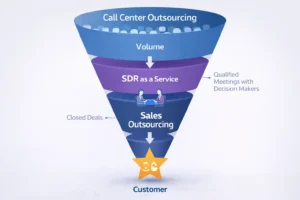
may be more appropriate when prospecting, qualification, follow-up and opportunity management need to operate as part of the same commercial function.
The decision should not be simply:
“Should we hire an SDR?”
The better decision is:
“What part of the sales system do we need to build for Spain?”
A company may need market mapping, ICP validation, SDR outreach, lead qualification, follow-up, sales coordination or a more complete outsourced sales operation.
That is why B2B sales outsourcing should not be treated as isolated activity.
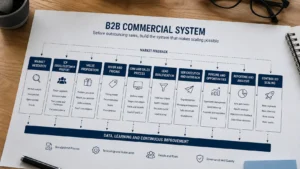
It should be treated as system design.