The Core Issue: Not Selling More, but Starting September Stronger
Summer is not always the right moment to push aggressive closing activity. In many B2B markets, the buyer is slower, internal approvals are delayed and decision-making moves into September.
That does not mean the commercial operation should stop.
The real objective is to avoid returning in September without knowing which leads are still active, which accounts require follow-up, which contacts belong in marketing, which opportunities should be disqualified and which dormant clients may be worth reviewing.
A company that enters September with a clean CRM, segmented pipeline and defined next actions has an operational advantage. A company that waits until September to recover context starts late.
The Real Cost: Sales Capacity Lost to Poor Visibility
In B2B sales, some decisions naturally move after summer. Complex deals often depend on multiple stakeholders, procurement, finance, management approval or budget confirmation.
That is normal.
What is not normal is losing visibility over the commercial status of each opportunity.
- Which lead requested information?
- Which company replied but was not ready?
- Which proposal was sent without follow-up?
- Which decision-maker asked to reconnect later?
- Which dormant account could be reactivated?
- Which opportunity no longer fits the ICP?
- Which contact is not ready to buy but still has marketing value?
When this information is unclear, the sales team returns with operational friction. Before selling, they have to reconstruct context: checking emails, reviewing spreadsheets, searching notes, asking colleagues or trying to remember the last interaction.
That has a direct cost.
Every hour a sales team spends searching for information is an hour not spent on qualified conversations, proposal follow-up or revenue-generating activity. The ROI of a sales team depends not only on activity volume, but on how much of that activity is directed at the right accounts, at the right time, with the right context.
CRM Discipline Is Not Administration. It Is Revenue Protection.
In a mature B2B operation, CRM discipline is not a back-office task. It is part of revenue protection.
A CRM, spreadsheet or internal database should help the company answer basic commercial questions: what opportunities exist, what stage they are in, what action is required, who owns the next step and what should be ignored.
The tool itself is not the strategy. But fragmented data creates execution risk.
If commercial information is spread across email, spreadsheets, WhatsApp, forms, personal notes and individual memory, the company does not have a reliable pipeline. It has disconnected fragments of commercial activity.
That fragmentation affects prioritisation. It increases wasted effort. It creates follow-up gaps. It weakens sales forecasting. And it makes September slower than it needs to be.
The objective is not to build a complex CRM architecture during the summer. The objective is to create enough structure for the sales team to know where to look, what to prioritise and what action should happen next.
Not Every Lead Has the Same Commercial Value
One of the most common pipeline problems is treating all leads as if they belong in the same category.
They do not.
Some contacts are active opportunities. They have a current need, a clear fit and potential to move forward. Others are future opportunities: they match the target profile but are not ready to buy now. Some contacts belong in marketing because they read, follow, recognise the brand or may become useful later. Others should be disqualified because they do not fit the company’s ICP. Some records are incomplete and need basic qualification before any commercial decision is made.
This segmentation is not cosmetic. It protects sales capacity.
If the sales team treats an active decision-maker, a cold contact, a marketing audience member and a disqualified company in the same way, the result is poor prioritisation. Time is spent where it should not be spent, and valuable future opportunities may be ignored because they were not ready to buy immediately.
A disciplined B2B pipeline should distinguish between active opportunities, future opportunities, marketing contacts, disqualified leads, non-interested contacts and incomplete records.
That distinction improves focus. It reduces waste. It makes the sales operation more predictable.
Dormant Accounts Are Not Dead Accounts
New lead generation is important, but many companies overinvest in new acquisition while ignoring accounts that have already bought from them.
Dormant accounts are often treated as closed history. That is a mistake.
A former client already knows the company. There is existing context, brand familiarity and some level of previous trust. That does not mean the account will return automatically. But it does mean it should be reviewed differently from a completely cold prospect.
The correct question is not only why the client left. The stronger commercial questions are:
- Why did they buy in the first place?
- What problem were they trying to solve?
- Why did the relationship stop?
- Was the issue price, service, timing, internal change, budget, lack of follow-up or a better competitor?
- Is there a new trigger that could justify reactivation?
- Does the account still fit the current ICP?
Some dormant accounts will not be worth pursuing. Some no longer fit. Some were lost for reasons that make reactivation unlikely.
But others may have a new need, a different internal structure or a better reason to reopen the conversation. In some cases, reactivating a dormant account may require less effort than opening a completely new cold opportunity, because the relationship does not start from zero.
A strong commercial base does not only look forward. It also reviews where previous value was created and why it stopped.
Summer Problem, Operational Solution
The summer slowdown creates several operational risks. Each one has a clear commercial response.
If leads are dispersed, the solution is to centralise commercial information into one reliable base.
If salespeople are wasting time reconstructing context, the solution is to define stages, priorities and next actions.
If contacts are mixed without criteria, the solution is to segment them by commercial function: active sales, future follow-up, marketing, disqualification or further qualification.
If dormant accounts have been ignored, the solution is to review why they bought, why they stopped and whether reactivation is realistic.
If September usually starts with confusion, the solution is to prepare the pipeline during July and August.
The summer period may not always increase short-term closing volume. But it can reduce commercial waste, improve pipeline visibility and protect sales productivity before the next cycle starts.
What Not to Do During the Summer Slowdown
Summer should not be used for commercial activity without criteria.
It is not about making aggressive calls in August. It is not about pushing contacts who have already said no. It is not about sending generic messages to the entire database. It is not about confusing activity with progress.
It is also not advisable to wait until September to clean the pipeline. That is one of the most common operational mistakes. The company returns from summer, tries to recover momentum and discovers that before selling, it must clean lists, review stages, find old conversations and decide which opportunities are still alive.
That work should already be done.
September should not begin with fragmented data and unclear priorities. It should begin with commercial visibility.
Where an External Execution System Fits
Many companies understand the work that needs to be done but lack the internal capacity to execute it during the summer. Teams are reduced, managers are unavailable and salespeople should not spend valuable time cleaning data, chasing context or rebuilding commercial history.
In that context, it can make sense to work with an
external commercial execution system.
The value is not in adding an isolated external person. The value is in adding a structured execution layer with team, process, follow-up, reporting and control.
An external system can support lead review, account qualification, CRM updates, follow-up calls, opportunity classification, dormant account review, minimum response coverage and September campaign preparation.
Depending on the need, this can include
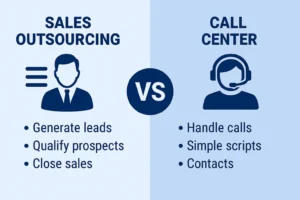
B2B sales outsourcing,
outsourced SDR support,
lead management, operational support or
B2B call center outsourcing
to maintain commercial continuity.
The point is not to generate activity for the sake of activity. The point is to keep the commercial operation under control.